Motivation
A machine learning cluster needs a secure way to expose services to users, as well as to interconnect servers across the public network. For this, a VPN network needs to be deployed.
Deploying a VPN network requires considering the following factors:
- Network topology: an appropriate topology must be chosen to minimize latency as much as possible;
- User management: it should be easy to add or remove users and to authorize them;
- Simplicity of use and maintenance.
Design
Network Topology
The network topology determines the latency.
The lowest-latency option is obviously full-mesh, i.e. every pair of peers has a direct P2P connection. However, the management complexity of this topology is $\mathcal{O}(n^2)$, and adding a new peer requires modifying the configuration files of all other peers. It also has to deal with the problems introduced by NAT, which requires some automated management software. I tried Netmaker and Headscale, but neither of them seemed able to correctly handle the complex network environment within the campus, such as the symmetric NAT used by various enterprise-grade routers, and the probability of successfully establishing P2P was very low.
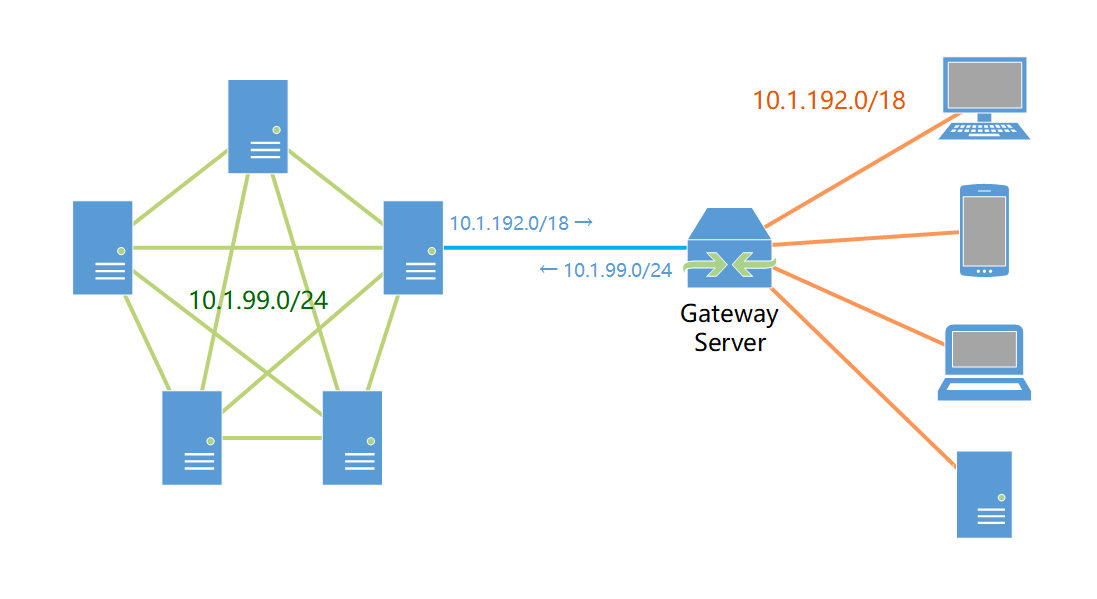
In the end I chose a topology that combines full-mesh and hub-and-spoke. Since the number of servers and their IPs rarely change, manually configuring a full-mesh network among the servers is feasible. At the same time, a gateway server is provided as the hub for user access, and users only need to establish a connection with the gateway server. Since most users actually use the VPN within the campus, connecting to the on-campus gateway server and forwarding traffic through it does not introduce much additional latency. This structure balances latency and management complexity, and adding/removing and authorizing users only needs to be done on the gateway server.
Protocol Choice
The popular OpenVPN and IPSec are both good enough, but the emerging WireGuard offers unparalleled configuration simplicity. On the server side, WireGuard can define a peer and a route with just a few lines of configuration; on the user side, since WireGuard uses key-pair-based authentication, a single configuration file is enough to join the VPN network, with no need to remember an additional password or perform a login operation.
Management Approach
For the sake of predictability and stability, I chose the manual configuration approach. The full-mesh network among servers does not need to be changed frequently once it is configured. User management, on the other hand, is implemented through a script: when a new user needs to be added, the script generates a key pair and allocates an IP, adds the public key and routing information to the gateway server’s peer list, then generates a configuration file containing the private key and the allocated IP, and sends it to the user.
Example of a user peer configuration on the gateway server:
| |
Example of a user’s access configuration file:
| |